The ground beneath the digital boom
Data centers are no longer niche infrastructure projects. They are rapidly becoming some of the largest and most complex construction programs underway, driven by growth in artificial intelligence, cloud computing, e-commerce and digital services. Entering this year, nearly 50 million square feet of new data center facilities were under construction across the US, each one a fortress of connectivity, efficiency and raw energy demand.
For underground construction professionals, this demand is more than a market shift, it’s a call to action. And OEMs like Ditch Witch are closely tracking how this surge is reshaping underground construction. The digital world may thrive in the cloud, but it’s anchored in the ground. Beneath every data hub lies a complex, unseen labyrinth of power, water and fiber, the essential lifelines contractors are uniquely equipped to deliver.
However, data centers don’t follow the blueprints of a typical build. They need a significant amount of energy to power their high-performance computing racks and often large amounts of water to cool those assets. The opportunity is significant, but so are the expectations, as these facilities require complex, large-scale utility ecosystems. For those prepared to meet the demands, the sector promises steady, large-scale work.
The scale and pace of data center development are driving a surge in underground utility work. Contractors who succeed will be those who rethink how they plan, equip and use jobsite intelligence to stay ahead of increasingly complex underground conditions.
Scaling up underground
Fast deployment of data centers requires having all hands, and machines, on deck. To meet tight deadlines, contractors often need to operate multiple machines simultaneously on site. That makes upfront logistics planning essential to coordinate moving parts, manage parallel work, and prevent equipment or workforce bottlenecks.
As data centers become major drivers of underground construction, contractors must adapt to meet their immense utility demands. Understanding the core infrastructure requirements of these large-scale projects is key.
Unlike smaller utility extensions or fiber-to-the-home builds, data centers require infrastructure on a completely different scale. They demand:
Electric: Data centers require multiple high-capacity feeders from utility interconnects, often ranging from 115 to 230 kV, integrated into campus substations. These projects necessitate concrete-encased multi-cell duct banks, thermal backfill or precise spacing to meet ampacity models, and extensive vault and manhole networks for efficient cable pulls and maintenance.
Water: Essential for cooling, make-up water systems may use reclaimed or industrial sources where permitted. Data centers also incorporate process or reverse osmosis (RO) lines, alongside comprehensive fire-protection loops equipped with isolation and metering.
Fiber: To support robust data transmission, data centers need geodiverse carrier entrances and extensive long-haul laterals. High-strand trunks and diverse path configurations are critical to ensuring reliability. This combination of scale and resilience makes data center work far more complex than typical underground projects.
Where planning meets the bore path
Establishing reliable, high-capacity connections for these utilities requires precise and efficient utility installation. Using underground installation methods will help protect infrastructure, maintain surface integrity and maximize the data center’s long-term operational stability.
Most underground installations can be open cut at a depth of three to five feet. Horizontal directional drilling (HDD) at anywhere from 10- to 60 feet deep can be reserved for installations in hard-to-access areas and when surface disruption must be avoided, like underneath roads.
Underground utility lengths can range from 500 feet to 15,000 feet depending on if a data center has on-site utility connections. Contractors can expect to run fiber in 1- to 6-inch conduit and power in 4- to 6-inch multi-cell duct banks.
Every project should begin with soil and site analysis, identifying underground obstacles and depth requirements.
These findings inform machine selection, tooling, and installation method, ensuring safe and efficient execution.
The equipment mix that keeps pace
Precision and productivity are crucial in data center construction, underscoring the importance of selecting the right equipment. Most commonly used equipment for data center construction include:
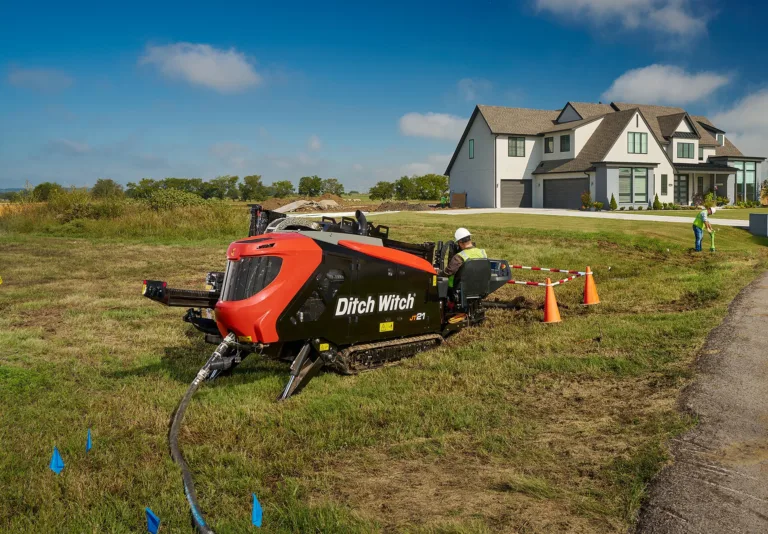
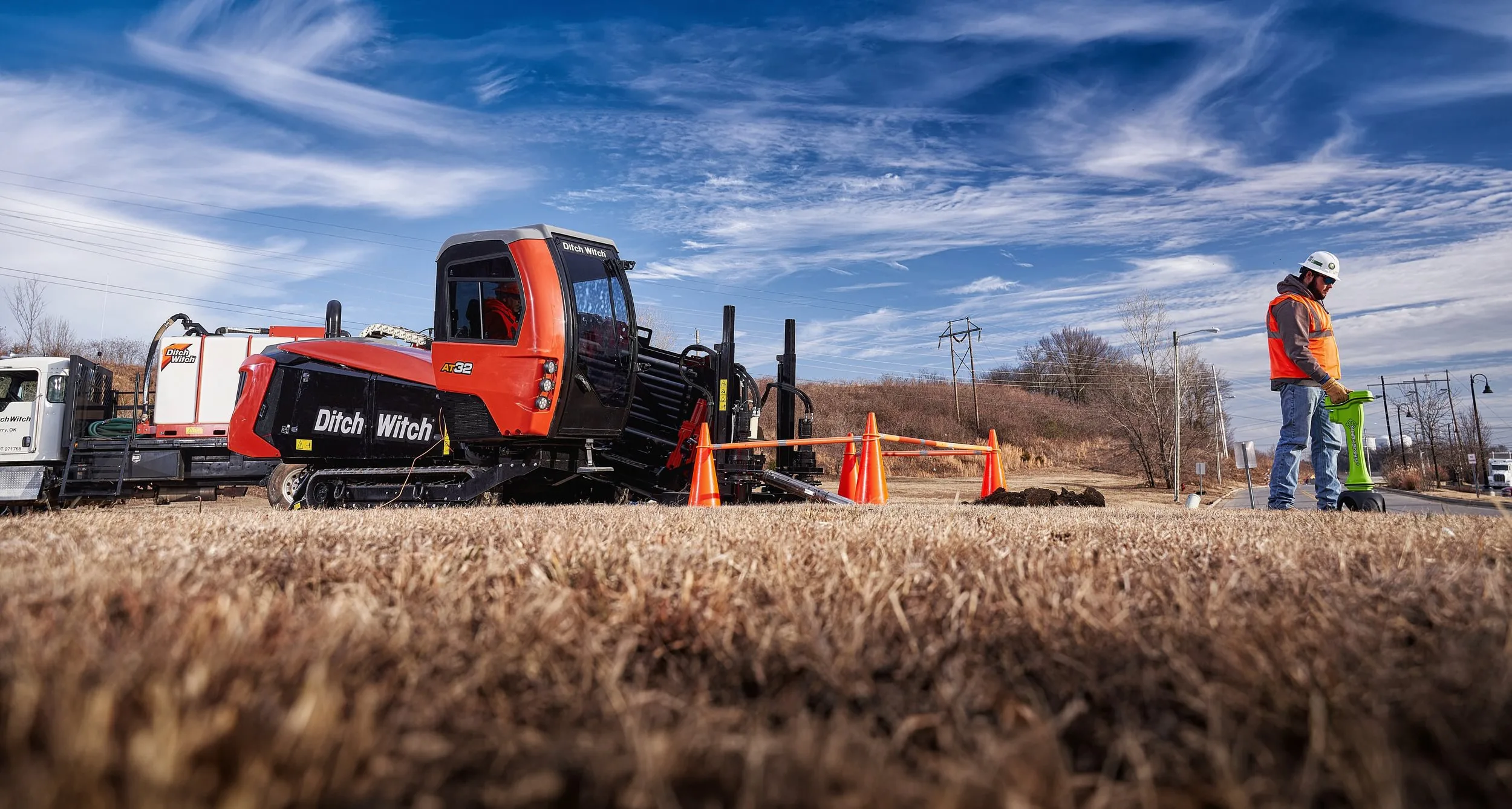
Horizontal directional drills (HDD) are indispensable for burying conduits beneath roads and buildings without disrupting the surface. Equipped with All-Terrain technology, HDD rigs navigate challenging terrains with precision, allowing access to hard-to-reach areas while minimizing environmental impact.
Mixing and recycling systems play a critical role in fluid control during lengthy or rocky bores, ensuring smooth and efficient operations.
Vacuum excavators, essential for potholing and conflict checks, manage excavation fluids effectively, further enhancing site safety and efficiency.
Trenchers and microtrenchers cut narrow trenches for conduits, cables, and ducts, making them ideal for on-campus fiber installations and shorter runs. Their versatility allows them to operate across various soil types, from compacted ground to rocky terrains, making them perfect for projects that require branching or dual ducts.
Vibratory plows offer quick, minimally invasive installation for conduits and cables in soft soils, providing rapid results with minimal surface disruption. These machines excel in environments where speed and minimal restoration are priorities.
Guidance and locating tools, like Subsite systems with wireline or gyro capabilities, are essential for navigating long, deep, or EMI-heavy bores, ensuring accuracy and efficiency throughout the project.
To optimize efficiency and minimize disruption, a hybrid approach is often best. Use vibratory plows for long stretches in soft soil, trenchers for deeper or more complex installations, and HDD in areas where surface disruption is a concern, such as under roads.
Execution beyond machines
Successful data center construction requires more than just the right equipment, and technology alone doesn’t guarantee success.
Contractors should also consider:
- Rock tooling: Use PDC and TC bits, and hole openers for rocky conditions.
- Purpose-built pull heads: Essential for handling multi-duct bundles.
- Drilling fluid management: Prevent losses and protect geological formations.
- QA/QC and documentation: Maintain strict quality assurance and clear documentation.
- Safety and logistics planning: Critical for managing large crews and multiple moving parts.
A long-term market, not a short-term surge
The outlook for data center construction is one of sustained expansion and escalating complexity. Rising demand for fiber mileage, larger duct bank systems, and advanced water infrastructure will keep utility contractors at the forefront of this work. However, power constraints may also continue to push on-site generation and alternative cooling solutions, expanding the underground scope even further.
Opportunity alone, however, will not determine success. Contractors who lead in this market will be those who plan early, deploy the right mix of equipment and execute consistently under fast-track schedules. They will rely on proven installation methods, skilled crews and technology that supports accuracy, safety and documentation at scale.
For contractors prepared to meet its demands, the data center boom represents more than a busy backlog. It is a chance to establish long-term partnerships, demonstrate technical leadership and help build the infrastructure that supports the digital economy for decades to come.