Proper pairing of your stand-on skid steer and its tools
Key Takeaways
- Pairing makes the machine: A mini stand-on skid steer becomes a versatile, productive trencher only when matched correctly to the right attachment and job.
- Valued for versatility: Utility and landscaping contractors increasingly use mini stand-on skid steers for trenching jobs.
- One Machine, fewer to haul: Running one mini skid steer across many jobs means you’re hauling less equipment and keeping operator training simple.
- Match pairing to operational goals: Contractors should pick machine-and-attachment pairings that dig efficiently, minimize downtime, keep small crews productive and boost ROI.
Mini stand-on skid steers are valued for their versatility. Today, many utility and landscaping contractors prefer to use mini skid steers for trenching.
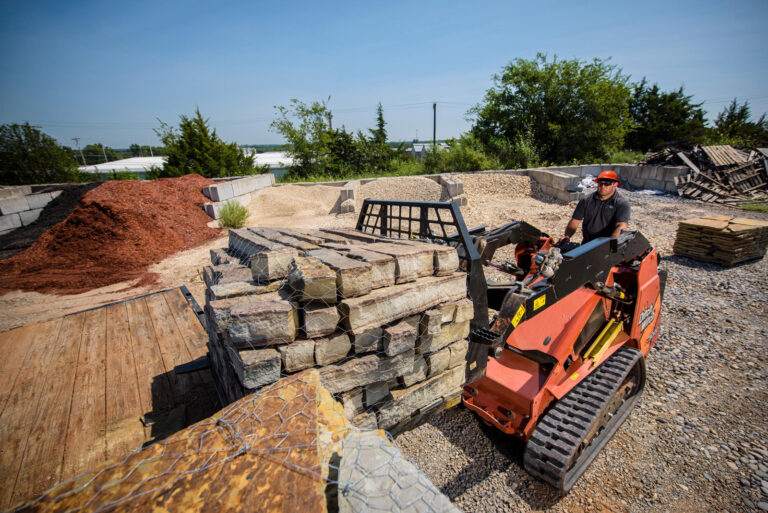
With a quick and simple connection of a trencher attachment, a mini stand-on skid steer can start digging out dirt and cutting through rocky soils to support efficient installations of fiber, irrigation and other lines. And by using a single machine to do a wide range of jobs, you can reduce the number of machines you need to transport to and from jobsites, while also simplifying training for operators.
However, there’s a lot to consider when outfitting a mini stand-on skid steer with a trencher attachment. For example, contractors should think about how their machine and attachment pairing can help address their operational needs. Whether it’s digging more efficiently, minimizing downtime or getting more from their equipment to keep smaller crews efficient, it’s important to determine which machines and attachments can help operators boost their ROI and stay efficient.
Here are a few considerations when selecting a mini stand-on skid steer and trencher attachment.
Identify the jobsite and project needs
When considering renting or purchasing a mini stand-on skid steer with a trencher attachment, contractors should first identify the full range of projects that their machine will support. This will help guide their decision on what specific machine and attachments are right.
Mini stand-on skid steers are available with a range of power and performance capabilities. A 24-hp machine can suffice for small-trench jobs, where contractors may only need to dig 2 feet deep and 4 inches wide. But a more powerful mini stand-on skid steer, like a 37-hp option, can deliver more power to hydraulic attachments to help contractors increase productivity on trenching and other jobs.
When it comes to trencher attachments, machine manufacturers vary in what they offer. Some offer one trencher attachment for all their machines. Other manufacturers offer multiple trencher attachments that are designed to be paired with specific machines.
The latter approach lets contractors choose a trencher attachment that performs well with the machine that they’ve identified as the best fit for their jobsite. This is crucial when it comes time to start digging because if their machine doesn’t run a trencher chain at the right speed, it can lead to stalls and make trenching jobs less efficient.
When buying a trencher attachment, some contractors choose to go with a larger boom and use it for trenching at various depths. But this approach can create challenges. For example, trying to dig at 2 feet with a 4-foot boom can lead to workers guessing if they’re trenching at the right depth, resulting in a lot of measuring, double-checking on the jobsite and unnecessary downtime. By using the right-sized boom, contractors can plunge it all the way and know they’re trenching at the right depth.
Boost productivity for smaller crews
In today’s tight labor market, easing work and improving comfort for contractors is more important than ever. Mini stand-on skid steers can help ease the demands put on smaller crews in various aspects of their operations:
Training: A key benefit of using a mini stand-on skid steer for trenching is its small learning curve. If a contractor’s team is familiar with the machine and have used it for other functions, then they’re already well on their way to knowing how to run it as a trencher. Additionally, trenching with a stand-on skid steer helps improve efficiency by allowing operators to move in reverse, giving them a 360-degree view of the jobsite.
Operating: Improvements to hydraulic systems over the years have led to upgrades in operator comfort with stand-on skid steers. In the past, operating hydraulics may have felt like a feat of strength. But today’s hydraulic systems allow users to move joysticks with minimal pressure. Some machine models also offer a choice of single- or double-joystick control, allowing users to choose the control method that they’re the most comfortable with and efficient in operating.
Changing: The process of replacing attachments on many machine models is simple and straightforward.
Two hydraulic hoses with quick-connect couplets allow users to easily unplug to disengage the hydraulic power and then connect a new attachment — all in a time span of about one minute. Drip-free and flat-faced couplers also prevent oil from dripping off a machine when disconnecting an attachment. This can simplify jobsite cleanup and improve your overall environmental footprint.
Maintaining: Modern mini skid steers and their attachments incorporate a variety of design features to help ease maintenance and extend uptime.
Some machines offer color LCD displays with direct visibility into engine diagnostics. And high-drive track systems with interchangeable bolt-on rollers can provide longer-lasting performance. On the trencher attachment, features like an 11-tooth forged sprocket can produce faster chain speeds and increased chain life, and replaceable boom stubs can reduce both downtime and repair costs.
Understanding the configurations
Using good operating practices for mini stand-on skid steers and their attachments can help operators stay productive and extend the life of their equipment.
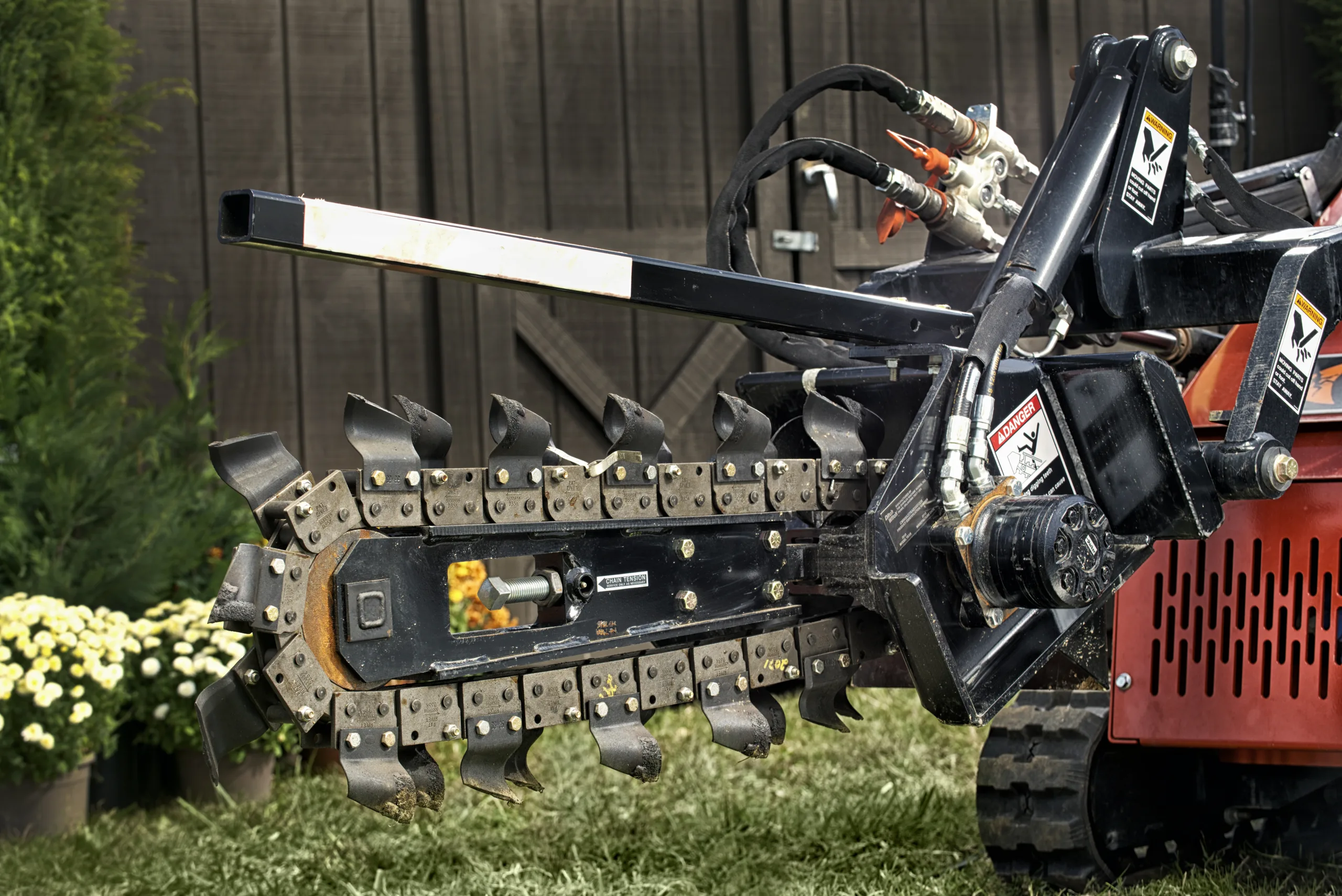
Perhaps the simplest step workers can take is monitoring a trencher attachment’s chain, teeth and sprockets for wear and tear. If the rollers start to look like an apple core or if the pin is visible, it’s time to replace them. The same goes for a sprocket when its teeth start thinning.
Another area for workers to keep their eyes on is chain tension. Chains that become too tight can create wear on the sprocket or sidebars. On the other hand, chains that start sagging can vibrate the equipment and also cause wear.
Some manufacturers apply carbide to reinforce the strength of the trencher teeth. When that carbide begins to wear down to the base steel, the teeth can become worn, which can diminish machine efficiency, and risk breaking off. Crews should either immediately replace worn-down teeth or replace all the teeth together.
Workers should also make sure they use the appropriate teeth on trenchers for the ground conditions to help maximize both tool life and operator efficiency. For example, a cup tooth is designed to dig in soft- to medium -type soils, while a shark tooth is well suited for breaking through harder soil. An alligator tooth is designed to chip away at and dig through rocky soil.
As always, local dealerships are often knowledgeable about regional soil conditions and can help you set up your machine for success.
An efficient and effective pair
A mini stand-on skid steer with a trencher attachment is a versatile solution to help meet a variety of jobsite needs. And when the right mini stand-on skid steer is paired with the correct attachment, it can create an effective and efficient tool for trenching in landscaping and construction grade projects.
By using a single machine to do a wide range of jobs, operators can reduce the number of machines they need to transport to and from jobsites, as well as enable contractors to take on more tasks even when working with a smaller crew.